

Earlier in November, we gathered in Portcullis House to launch our report, Strengthening NHS wheelchair services: commissioning with confidence. This was the result of many months of collaboration with the Wheelchair Alliance and the All-Party Parliamentary Group (APPG) for wheelchair users.
Around 70 guests joined us. They included wheelchair users, MPs and peers, wheelchair providers, commissioners and policymakers from NHS England. Everyone came to hear our findings and share their views on how to improve wheelchair services for the people who rely on them.
Hearing from people with lived experience
The event opened with a powerful account from Alex Cowan, a wheelchair user, disability consultant and advocate. Alex told us that the delays in getting equipment and repairs described in our report have been known and talked about in the disability community for many years. She welcomed our report for shining a light on these system-wide issues.
She told us about the day her wheelchair's power pack broke after many years of use and she could not get a replacement. This meant that, on days when she could not propel her chair herself, she could not leave the house. Her story shows how badly service failings can affect people's lives.
From people’s houses to the Houses of Parliament
The Ombudsman, Paula Sussex, then set out the report's findings. We’ve seen a huge increase in complaints about wheelchair services – from 8 (2020 to 2021) to 110 (2025 to 2026). More than 80% of these were about services delivered by independent providers. Behind those numbers are children who lost out on their education because they could not attend school and adults who lost their independence.
Our report makes three recommendations to Government and NHS England:
- stronger national oversight, data and quality assurance by the Department of Health and Social Care (DHSC) and NHS England
- better support for integrated care boards (ICBs) to commission sustainable, person-centred services
- measuring services by people's experiences and outcomes.
Behind Paula, the screen showed a comment from Graham who had complained to us:
‘I like to be independent and take my dogs for a walk, but it got to the point where I wouldn’t go out without my son in case I needed him to push me home. The wheelchair is effectively my legs, I need it to live my daily life.’
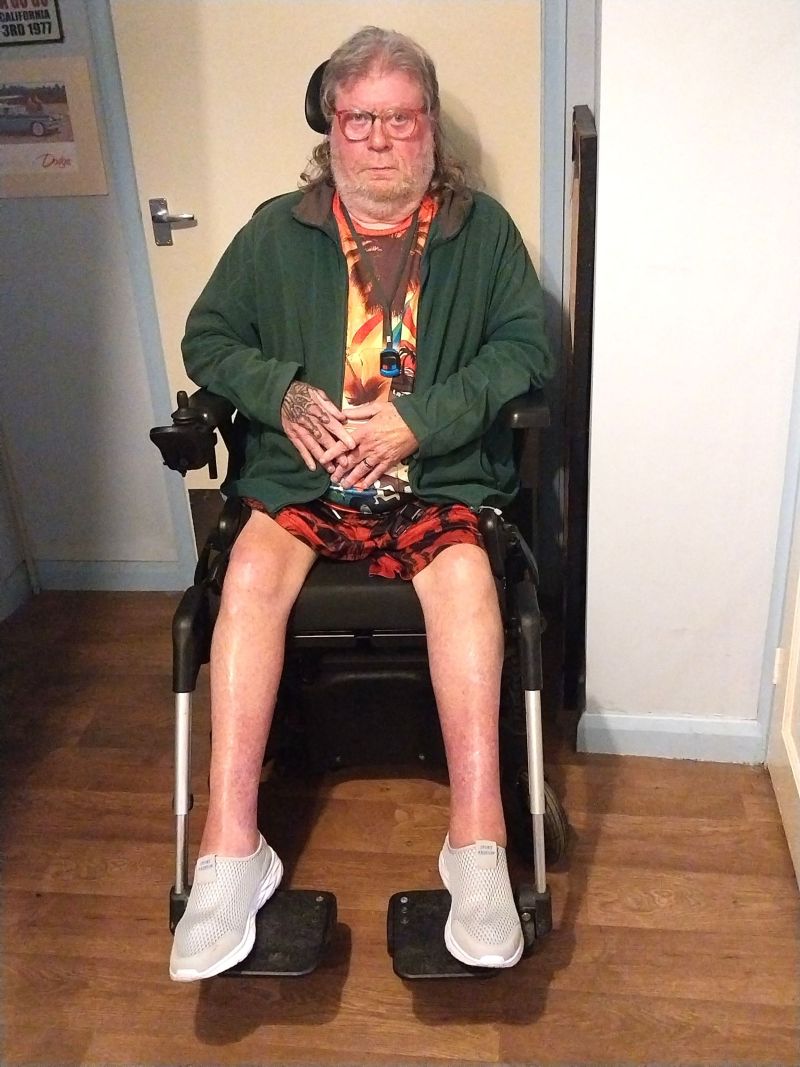
One of our caseworkers who had investigated their complaint was in the room and said:
‘It was powerful to see words spoken in the complainant’s living room taken into the Houses of Parliament.’
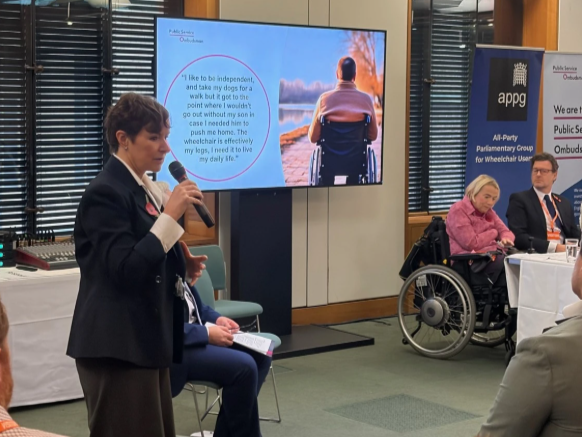
That moment really demonstrates the power of complaints. For the person who makes it, one complaint matters. Alongside others like it, it can lead to real change.
We also heard views that the current approach to commissioning services represents a poor investment of public funds. Helping children into education, and adults into work and independent living, can reduce inequalities and avoid higher health and social care costs in future. Getting wheelchair services right is therefore a valuable investment in the wider economy too.
Building on our recommendations
Our Chief Executive, Rebecca Hilsenrath then chaired a panel with:
- Alex Cowan
- Nick Goldup, Chief Executive of the Wheelchair Alliance
- Mat Pickering, Chief Executive of AJM Healthcare
- Patience Young, occupational therapist and former ICB commissioner for wheelchair services in Hull.
Together, they discussed how to build on our recommendations.
There was strong support for greater central leadership of wheelchair services and clear accountability for ICBs. There was also agreement that ICBs need much better data to be able to act as strategic commissioners. We heard that all 25 ICBs are keen to work together on this and the Ombudsman has committed to supporting them.
What’s happened since the launch
There was clear agreement that this report must not sit on a shelf. Early signs are encouraging. Since the launch, Lord Hunt has tabled amendments on wheelchair services to the Health Bill that is currently in the House of Lords. The amendments aim to prompt a government response and ask the Minister to meet the Ombudsman. We will follow up with NHS England and the Department of Health and Social Care to plan the next steps.
The Ombudsman and some of the people who complained to us have also been interviewed for local and national media, including The Sunday Times, The Guardian, BBC and ITV. This has helped further raise public awareness of the issues and the need for urgent improvements to wheelchair services.
We will keep pressing for better commissioning of wheelchair services, so that people can get the equipment and repairs they need without long delays. To hear more, look out for our December podcast, when we’ll explore this topic further with Nick Goldup from the Wheelchair Alliance.
We are grateful to Daniel Francis MP, chair of the APPG, for hosting the event.